ECONATANT CONSULTING
Environmental Policy Brief | November 2026
Oyindamola Daniels and Adefarati Oloruntoba, PhD
Canada's Landfill Methane Regulations: Environmental Effectiveness, Compliance Costs and Implementation Challenges
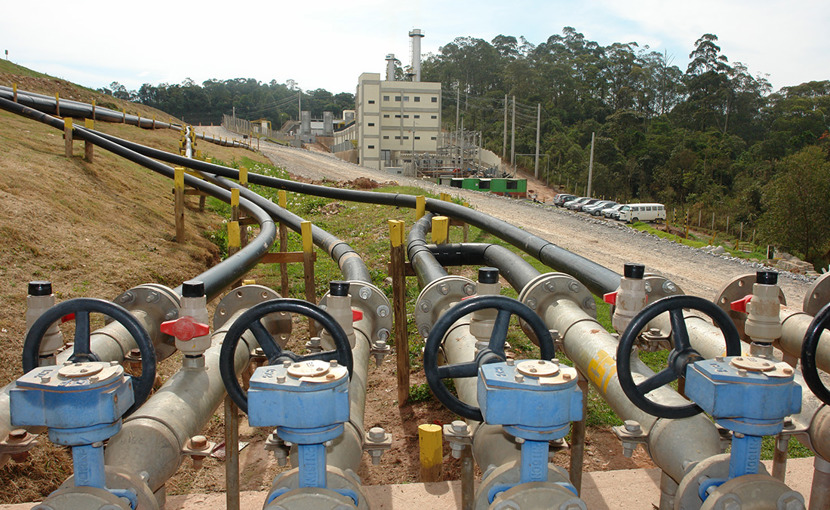
Landfill gas recovery infrastructure. Photo credit: Alis Alberta
Executive summary
Canada's Landfill Methane Regulations (SOR/2025-279), registered on December 12, 2025, establish the country's first dedicated federal framework for reducing methane emissions from eligible municipal solid waste landfills. Enacted under the Canadian Environmental Protection Act, 1999 (CEPA), the regulations introduce national requirements for methane generation assessment, gas recovery and destruction, equipment inspections, surface emissions monitoring, corrective action, recordkeeping and annual reporting.
The regulations respond to a significant source of greenhouse gas emissions. In 2023, Canadian landfills accounted for approximately 17% of national methane emissions and 2.7% of total greenhouse gas emissions. Although provinces such as British Columbia, Ontario and Quebec already required methane control at qualifying facilities, differences in regulatory coverage and operating requirements contributed to an uneven national framework.
The federal government projects that the regulations could reduce landfill methane emissions by approximately 50% below 2019 levels by 2035. Over 2026 to 2040, the Regulatory Impact Analysis Statement estimates cumulative reductions of about 100 million tonnes of carbon dioxide equivalent (Mt CO₂e), compliance costs of $808 million and monetized climate benefits of approximately $9.5 billion. The projected net benefit is $8.7 billion, with an average abatement cost of about $8 per tonne CO₂e. The regulatory design has several strengths. It establishes common minimum methane control requirements across Canada, mandates regular inspections and corrective actions, and extends obligations to qualifying landfills that may not be covered by existing provincial methane control thresholds. It also permits several gas destruction and utilization technologies, including flaring, energy recovery and specified biological treatment systems.
Nevertheless, implementation raises important questions about the accuracy of modelled methane generation, differences between measured concentrations and actual atmospheric emission rates, the financial capacity of smaller municipalities, and overlapping federal and provincial compliance obligations. The interaction with carbon offset programs may also affect project financing and investment decisions. Econatant considers the new regulations a considerable improvement in Canadian landfill methane policy, with projected climate benefits that considerably exceed estimated costs. However, the achievement of these benefits will depend on effective implementation, sound emissions measurement, transparent reporting and coordinated regulatory oversight. Stronger federal and provincial coordination, complementary independent emission verification, targeted assistance for facilities facing high compliance costs, better integration with organic waste diversion policies, and public disclosure of aggregated regulatory performance indicators are recommended.
1. Canada's Landfill Methane Emissions and Policy Development
Methane (CH₄) is a potent greenhouse gas released from energy production, agriculture and waste management. According to the Intergovernmental Panel on Climate Change (IPCC, 2021), methane has a global warming potential approximately 27 to 30 times that of carbon dioxide (CO₂) over 100 years, depending on its source and the accounting convention applied. In municipal solid waste landfills, methane is generated through the decomposition of biodegradable materials under oxygen limited conditions. While landfill gas recovery systems can capture methane for destruction or energy utilization, emissions can still occur through landfill surfaces, damaged covers, extraction wells and equipment leaks.
Landfills accounted for approximately 17% of Canada's methane emissions and 2.7% of national greenhouse gas emissions in 2023, making them an important source for mitigation. Figure 1 shows projected annual waste disposal and methane generation at federally regulated landfills between 2026 and 2040. Annual waste disposal is expected to remain relatively stable at approximately 18 million tonnes, as increased waste diversion in some provinces partly offsets additional waste generated through population growth. Despite this relative stability, modelled methane generation increases from approximately 919 kilotonnes in 2026 to a peak of 977 kilotonnes in 2034, before declining modestly to 957 kilotonnes by 2040. This pattern reflects the continuing decomposition of previously disposed organic waste and changes in projected future disposal quantities.
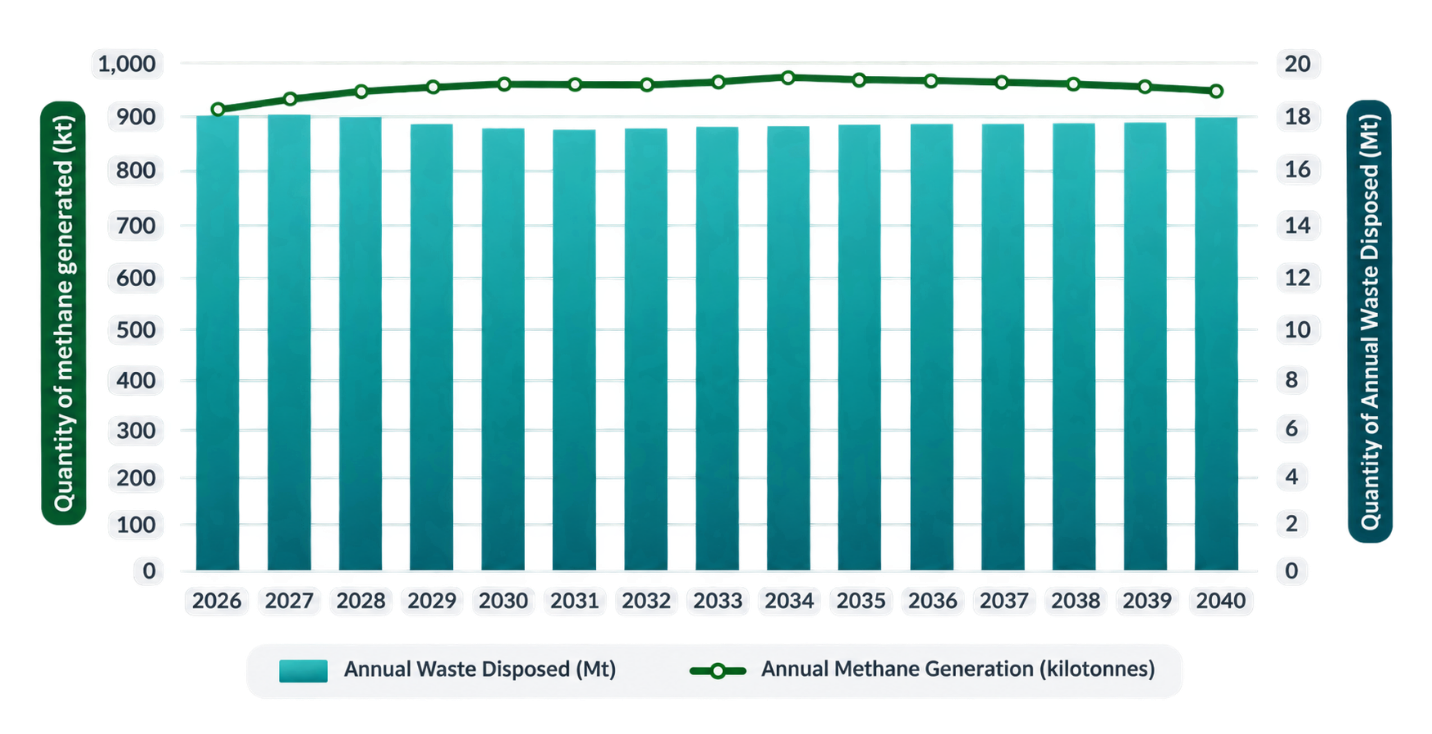
Figure 1. Projected annual municipal solid waste disposal and methane generation at federally regulated Canadian landfills, 2026 to 2040. Source: Canada Gazette, 2025
These projections demonstrate the persistence of landfill methane generation even where annual waste disposal remains broadly unchanged. They also highlight the need for sustained gas recovery, monitoring and complementary organic waste diversion measures.
Before December 2025, landfill methane management in Canada was governed principally by provincial environmental legislation, operating approvals and voluntary mitigation projects. British Columbia, Ontario and Quebec had established gas capture requirements for qualifying facilities, while Alberta relied more extensively on landfill operating standards, environmental approvals and greenhouse gas offset mechanisms. At the federal level, the Greenhouse Gas Reporting Program, established in 2004, required qualifying facilities to report emissions but did not impose nationwide methane recovery or surface concentration limits.
To address these regulatory differences, the Government of Canada introduced the Landfill Methane Regulations (SOR/2025-279) on December 12, 2025, under the Canadian Environmental Protection Act, 1999. The regulations establish national requirements for methane generation assessment, gas recovery and destruction, leak detection, surface monitoring, corrective action and reporting. Their implementation is expected to contribute to Canada's methane reduction commitments, including the 2022 Methane Strategy objective of reducing national methane emissions by 35% below 2020 levels by 2030.
This policy brief evaluates the regulations' environmental effectiveness, economic implications, monitoring and verification provisions, implementation challenges, and interaction with provincial regulatory frameworks, with particular attention to Alberta, British Columbia, Ontario and Quebec.
2. Regulatory Applicability and Modelled Methane Generation
Section 3 generally applies to landfills where municipal solid waste was disposed of after January 1, 2010, with more than 450,000 tonnes in place; or where more than 20,000 tonnes were disposed of during 2025 or a subsequent year and more than 200,000 tonnes are in place. Specified exclusions apply to specified waste categories and qualifying landfill portions. These waste quantity criteria establish initial coverage. Separate methane generation thresholds determine when additional control requirements apply.
Section 4 requires applicable operators to calculate methane generated during the previous calendar year using ECCC's prescribed Landfill Methane Modelling Tool. Assessment reports include waste quantities and composition, modelled methane generation, operating status, facility identification and descriptions of existing gas recovery systems, biocovers and other controls. The ordinary reporting deadline is June 1. The initial assessment for 2025 was due June 10, 2026 (see table 1). Modelled methane generation differs from atmospheric emissions. The quantity emitted depends on methane recovery, oxidation and uncaptured releases. This distinction matters because generation thresholds determine regulatory obligations but do not directly measure environmental performance.
Table 1. Principal implementation milestones
|
Date or threshold |
Requirement |
|
December 12, 2025 |
Regulations registered and entered into force |
|
June 10, 2026 |
Initial methane generation assessment due |
|
January 1, 2028 |
Principal control requirements begin for qualifying facilities with existing recovery systems |
|
January 1, 2029 or later |
Requirements extend to additional qualifying facilities |
|
1,000 tonnes CH₄/year |
Principal threshold for earlier additional requirements |
|
664 to less than 1,000 tonnes CH₄/year |
Additional requirements generally begin in 2035 or the fourth year after assessment, whichever is later |
Source: SOR/2025-279, sections 3 to 6, 28 and 30. Individual commencement dates may differ because of registered offset projects, deferrals or other statutory conditions.
Sections 7 and 8 restrict landfill gas venting and require recovered gas to be conveyed to authorized destruction or utilization systems. Eligible technologies include flares, boilers, internal combustion engines, gas turbines, qualifying treatment systems and biofilters. Other eligible destruction devices must meet the prescribed methane destruction efficiency, generally 98%.
Technology flexibility accommodates differences in landfill size and gas quality. However, gas utilization projects should be evaluated against capital costs, energy demand, methane destruction efficiency and available markets rather than assumed to be economically preferable to flaring.
3. Methane Monitoring and Corrective Action
Section 10 requires monthly monitoring of applicable gas recovery wells. Operators must check gauge pressure above 0.5 inches of water, oxygen concentration exceeding 5% by volume, zero volumetric gas flow where measurement is possible, and damaged wellhead components. Abnormal conditions can indicate inadequate extraction, air intrusion, blockages or equipment failure. Section 11 requires prescribed follow up before the next monitoring event, including investigation of methane leaks and surface exceedances where applicable.
As summarized in Table 2, equipment components must generally undergo three methane leak inspections annually, separated by at least 60 days, using EPA Method 21 or an authorized alternative. A detected equipment leak is defined by a concentration of at least 500 parts per million by volume (ppmv). Within 30 days, the operator must confirm elimination or document a corrective action plan. Where repairs can be undertaken during operation, leaks generally must be eliminated within 90 days. Alternative maintenance shutdown arrangements and authorized extensions may apply. Surface monitoring applies principally to covered areas where waste disposal has not occurred within the preceding 12 months.
Table 2. Surface monitoring periods and concentration limits
|
Monitoring requirement |
Prescribed condition |
|
First monitoring period |
January 1 to May 31 |
|
Second monitoring period |
June 1 to August 31 |
|
Third monitoring period |
September 1 to December 31 |
|
Minimum interval |
60 days between monitoring events |
|
Individual surface exceedance |
500 ppmv or more |
|
Zone average exceedance |
25 ppmv or more over 4,500 m² |
|
Elevated location requiring attention |
Prescribed location of concern criteria, including readings around 200 ppmv |
|
Corrective action |
Confirm elimination within 30 days or prepare a plan |
|
Unresolved surface exceedance |
Generally eliminate within six months, subject to authorized deferral |
Surface measurements may use compliant ground instruments, qualifying drone systems under EPA Other Test Method 51, or methods approved by the Minister. Monitoring is subject to operational and weather restrictions, including prescribed wind limits. These provisions improve leak detection but cannot guarantee that intermittent emissions are identified between inspections.
4. Reporting, Verification and Enforcement
Section 4 assessments establish estimated methane generation and relevant regulatory thresholds. Section 22 separately requires annual operational reports once the additional provisions apply. Annual reports, generally due June 1, document landfill activities, recovered methane, gas destruction systems, operating hours, shutdowns, monitoring results, leaks, surface exceedances and corrective actions. Operators must maintain prescribed supporting records for at least five years under section 26. Electronic submissions and authorized signatures are addressed under section 27.
Three quantities must be distinguished: methane generated through waste decomposition, methane recovered by gas management systems, and methane actually emitted to the atmosphere. Model calculations estimate generation; flow meters quantify recovered gas; and surface inspections identify concentration exceedances. None independently establishes total atmospheric emissions. Econatant recommends complementary measurements at the site level for facilities with high modelled generation, repeated exceedances or substantial discrepancies between expected and recovered methane. Suitable approaches may include mobile measurement, atmospheric dispersion methods and appropriately validated drone-based surveys. Their application should reflect measurement uncertainty, site conditions and cost.
Contraventions are enforceable under the Canadian Environmental Protection Act, 1999. Section 29 also amends the federal regulations designating provisions for enforcement purposes. Designated contraventions can attract increased statutory penalties upon conviction, while other enforcement responses depend on the applicable CEPA provisions and circumstances. It is worth mentioning that the regulations do not establish a single fixed penalty for every monitoring or reporting failure. An enforcement assessment must identify the specific violated provision, the applicable offence category and relevant statutory penalty rules.
Section 6 permits an implementation deferral of up to two years in prescribed circumstances, including delays involving provincial approvals or necessary equipment. Applications must generally be submitted at least 180 days before the applicable commencement date. Section 23 allows certain repair or corrective action deadlines to be deferred by up to six months, with applications submitted at least 45 days before expiry. Section 24 permits cessation of specified obligations where qualifying conditions are satisfied. Whole landfill cessation may apply where annual methane generation or recovered methane is below 500 tonnes and six consecutive monitoring events demonstrate no surface exceedances, subject to the prescribed recovery system conditions.
The Minister must review the required documents and determine whether cessation is authorized. Closure or declining methane generation alone does not automatically terminate compliance obligations.
5. Federal and Provincial Regulations (British Columbia, Ontario, Alberta and Quebec)
The anticipated implementation of federal landfill methane controls varies considerably among provinces and territories. Figure 2 presents the distribution of 147 regulated landfill installations or compliance groups identified in the federal regulatory impact analysis, categorized by the principal implementation periods of 2028, 2029 and 2035.
Ontario accounts for the largest number (35), followed by Quebec (32), Alberta (27) and British Columbia (19). However, the need for new gas recovery infrastructure is distributed differently. In Alberta, 16 of the 27 regulated facilities (59%) are assigned to the 2029 new system group, compared with six of 11 in Saskatchewan (55%), three of six in Manitoba (50%), and one of 19 in British Columbia (5%). Prince Edward Island's single identified facility is also assigned to the 2029 new system group.
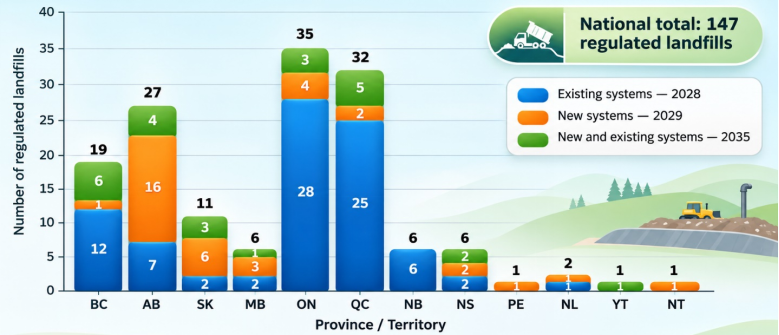
Figure 2. Projected number of regulated landfill installations by province, territory and federal implementation group. Source: data obtained from Canada Gazette, 2025
These differences indicate that compliance costs and infrastructure requirements will not be evenly distributed across Canada. Alberta and several Prairie jurisdictions may face comparatively greater investment needs for new methane control systems, whereas provinces with more established gas recovery infrastructure may require additional monitoring, equipment improvements and reporting measures. Alternative technologies, including engineered biocovers, could be appropriate at selected facilities, subject to technical feasibility, climatic conditions and demonstrated methane control performance.
As Table 3 shows, provincial requirements differ in their objectives, applicability criteria and monitoring methods. The federal regulations operate alongside these systems rather than automatically replacing them.
British Columbia's Landfill Gas Management Regulation, B.C. Reg. 391/2008, generally requires methane generation assessment at regulated sites with at least 100,000 tonnes of waste in place or receiving at least 10,000 tonnes annually. An annual methane generation threshold of 1,000 tonnes is relevant to gas management planning.
Ontario Regulations 232/98 and 347 require gas management for qualifying new, expanding and operating facilities, with a disposal capacity exceeding 1.5 million m³ forming a principal threshold. Both British Columbia and Ontario have established gas collection requirements. The federal framework adds prescribed national surface monitoring, leak detection and corrective action obligations.
Alberta's existing landfill framework is principally established through the Environmental Protection and Enhancement Act, the Standards for Landfills in Alberta, the Code of Practice for Landfills and individual environmental approvals. The 2010 landfill standards require subsurface landfill gas monitoring programs for applicable facilities, including measures to identify lateral gas migration and mitigate explosion hazards. Table 5.5 of those standards prescribes limits expressed as percentages of the lower explosive limit (LEL): 50% at property boundaries, 20% in specified onsite structures and 1% in specified offsite structures. These requirements address landfill gas migration and safety. They are distinct from the federal regulations' surface methane limits of 500 ppmv at individual locations and 25 ppmv averaged across a monitored zone.
Alberta also operates a landfill gas capture and combustion offset protocol. Eligible voluntary reductions may generate credits under the provincial emissions offset system, subject to additionality, quantification and verification requirements. The federal regulations introduce new mandatory methane control obligations at qualifying Alberta landfills. They may also affect future offset eligibility when formerly voluntary emission reductions become legally required. The federal economic analysis identifies 27 Alberta landfills across the three implementation groups: seven with existing systems in 2028, 16 requiring new systems in 2029, and four in the 2035 group. These requirements make Alberta an important implementation priority, particularly for infrastructure financing, regulatory coordination and project readiness.
Quebec's landfill framework establishes gas collection and control requirements for qualifying large disposal facilities, including those exceeding relevant 1.5 million m³ thresholds. Federal obligations add national monitoring and reporting requirements. Quebec's existing cap and trade and landfill methane offset arrangements also require attention when assessing project additionality and credit eligibility.
Table 3. Federal and provincial comparison
|
Feature |
Federal |
Alberta |
British Columbia |
Ontario |
|
Primary framework |
SOR/2025-279 |
Landfill standards, approvals and offset protocols |
B.C. Reg. 391/2008 |
O. Reg. 232/98 and Reg. 347 |
|
Main trigger |
Waste quantities and methane generation |
Applicable facility standards and approvals |
Waste quantity and methane generation |
Disposal capacity and facility status |
|
Quantitative threshold |
1,000 and 664 t CH₄/year |
Site approval conditions; prescribed subsurface LEL limits |
1,000 t CH₄/year for gas management planning |
Generally 1.5 million m³ capacity |
|
Monitoring focus |
Recovery wells, equipment and surface methane |
Subsurface migration, safety and approval conditions |
Gas recovery system performance |
Gas management and approval compliance |
|
Federal interaction |
National baseline |
Additional mandatory atmospheric methane controls |
Additional surface and leak obligations |
Additional standardized monitoring |
|
Key implementation issue |
National consistency |
New infrastructure and offset additionality |
Overlapping control requirements |
Coordination with existing approvals |
Alberta's principal challenge differs from that of provinces with longstanding gas collection requirements. In Alberta, new infrastructure and the interaction with voluntary offset projects are especially important, whereas British Columbia and Ontario may face more overlap between established and new compliance procedures.
6. Economic Assessment and Regional Distribution
ECCC projects cumulative reductions of about 100 Mt CO₂e between 2026 and 2040. Compliance costs are estimated at $808 million, while monetized climate benefits reach approximately $9.49 billion, producing net benefits of $8.68 billion. The national average abatement cost is approximately $8/t CO₂e. This is an estimate of the social cost of emissions abatement, not a guaranteed financial return to individual operators. The analysis also estimates an average compliance cost of $3 per tonne of future waste disposed at regulated landfills, equivalent to approximately 2% to 6% of typical tipping fees of $50 to $130 per tonne.
Regional costs vary with landfill size, methane generation, existing infrastructure, climate, construction requirements and the availability of qualified contractors. The federal analysis projects average abatement costs of $9/t CO₂e in Alberta, $11 in British Columbia, $6 in Ontario and $10 in Quebec. Costs are substantially higher in Yukon at $29 and the Northwest Territories at $17.
More importantly, the number of new systems required differs across provinces. Alberta's 16 new systems in the 2029 implementation group account for a substantial share of the 37 systems projected nationally in that group. The federal assessment also estimates average total compliance costs for new systems of $20.7 million at the largest landfill category, $6.0 million at intermediate facilities and $4.9 million at smaller regulated facilities. These are category averages, not budgets for individual projects. Municipal landfill operators may recover costs through tipping fees, user charges or property taxes, while private operators may pass some costs to customers. Consequently, positive national net benefits do not imply equal affordability across jurisdictions. Projected outcomes remain sensitive to actual methane capture performance, construction costs, project timing and the assumed value of avoided climate damages. Targeted assistance may therefore be justified for financially constrained facilities without weakening national emission reduction requirements.
7. Policy Effectiveness, Gaps and Recommendations
The current regulations improve national consistency through prescribed methane controls, monitoring and corrective action. Their principal limitation is that modelled generation and concentration monitoring do not provide a complete independent measurement of actual atmospheric emissions. A second challenge is regulatory coverage. Waste quantity and methane generation thresholds limit administrative burdens but may leave smaller methane sources outside the principal control requirements. Third, federal and provincial overlap may create additional documentation and monitoring costs where requirements are not coordinated. Fourth, methane capture addresses emissions after waste has entered a landfill. Organic waste diversion, composting and anaerobic digestion could reduce future generation, provided their environmental impacts are assessed consistently. Finally, the interaction with carbon offset programs could affect project revenues, particularly where previously voluntary methane reductions become mandatory.
Econatant recommends the following measures to improve implementation and regulatory effectiveness. ECCC and provincial regulators should develop coordinated compliance guidance, particularly for Alberta, British Columbia, Ontario and Quebec. ECCC should also introduce risk-based verification using complementary measurements at large emitters and facilities with repeated exceedances. Federal and provincial governments should evaluate targeted financial and technical assistance for municipalities requiring substantial new gas infrastructure, with Alberta's 2029 implementation group warranting particular attention.
Waste management policies should also combine landfill gas control with evidence based organic waste diversion measures evaluated through life cycle assessment and cost analysis. ECCC should publish aggregated indicators covering regulated facilities, implementation progress, methane recovery, detected exceedances, corrective actions and verified emissions reductions. These measures would improve confidence that regulatory compliance delivers measurable environmental benefits.
8. Conclusion
Canada's Landfill Methane Regulations establish a substantive national framework for methane control at qualifying municipal solid waste landfills. The projected 100 Mt CO₂e reduction and $8.68 billion net benefit provide a strong preliminary justification for the policy. Yet these estimates remain dependent on effective implementation, reliable monitoring and sufficient infrastructure investment. Provincial differences are particularly important. Alberta faces substantial new gas recovery requirements, while British Columbia and Ontario must reconcile established provincial systems with additional federal obligations.
Econatant concludes that the new regulations are potentially cost effective but should ultimately be evaluated against verified methane reductions, equitable compliance costs and consistent enforcement. Transparent performance reporting and targeted implementation support will be important in determining whether the projected national benefits are achieved.
References
§ Government of Canada. (2025). Landfill Methane Regulations, SOR/2025-279. Canada Gazette, Part II, 159(27). Regulations and Regulatory Impact Analysis Statement.
§ Government of Canada. (2026). Landfill Methane Regulations, SOR/2025-279. Justice Laws consolidated regulation.
§ Government of Alberta. (2010). Standards for Landfills in Alberta. Alberta landfill regulatory information.
§ Government of Alberta. Alberta Emission Offset System. Approved protocols, including Landfill Gas Capture and Combustion.
§ Government of British Columbia. (2008). Landfill Gas Management Regulation, B.C. Reg. 391/2008. Provincial legislation.
§ Government of Ontario. (1998). Landfilling Sites, Ontario Regulation 232/98. Provincial legislation.
§ Ontario Ministry of the Environment, Conservation and Parks. (2021). Landfill gas capture: A guideline on the regulatory and approval requirements for landfill gas. Official guideline.
§ Intergovernmental Panel on Climate Change. (2021). Climate Change 2021: The Physical Science Basis. Cambridge University Press. IPCC report.
§ Government of Canada. (1999). Canadian Environmental Protection Act, 1999, S.C. 1999, c. 33. Federal legislation.
Disclaimer: This brief assesses the regulatory framework and projected impacts based on legislation and official analyses available as of October 31, 2026. Estimates of future emissions reductions, compliance costs and economic benefits are government projections rather than independently verified results. Facility specific compliance obligations must be determined from the applicable legislation, provincial approvals and individual operating circumstances. ©2026